How to Take Notes During Meetings That Help You Win
Learning how to take notes during meetings is like learning a superpower. It's about turning talking and ideas into a clear plan. Good notes make sure that great ideas and important jobs don't get forgotten when the meeting is over. They help your whole team move forward.
Why Good Meeting Notes Are Your Secret Power

Have you ever left a meeting and forgot what was decided? It happens to everyone. When no one takes good notes, important talks become a blur. This can lead to missed due dates, talking about the same thing over and over, and feeling like you wasted time.
This isn't just a small problem. Grown-ups spend a lot of time in meetings. One study showed that 83% of workers spend almost one-third of their week in meetings. That's about 15 hours! You can read more meeting statistics to see how much time that is. With that much time spent talking, making it count is a big deal.
The Real Problem with Bad Notes
When notes are messy or don't get written at all, work slows down. Think of it like a leaky faucet. Important information drips away. No one sees the problem until a project is late and costs too much money.
Without good notes, it's hard to know who is supposed to do what. People remember things differently. Or worse, they forget who was picked for a big task. This makes the team have the same talk all over again. That's a sure way to make everyone feel stuck.
Good notes are like your team's memory. They stop confusion and turn talk into real work.
You Can Be the Team's Hero
When you learn how to take notes during meetings, you become very important. You're the one who remembers what the team decided. You can help everyone remember what to do next.
This doesn't mean you have to write down every single word. The trick is to listen for just a few key things:
- What We Decided: What did we say "yes" to?
- Jobs to Do: What are the next steps?
- Who Will Do It: Who is in charge of each step?
By writing down just these three things, your notes change from a big pile of words into a simple map. You help turn a messy talk into a clear plan. That makes you a big help to any team.
Get Ready for Success Before the Meeting Starts

The best notes start before the meeting even begins. A little bit of prep work—just less than five minutes—is the secret. It’s the difference between walking in with no plan and walking in ready to go.
You don't need to do a lot of research. Just look at the meeting plan to see what it's about. What problem are we trying to fix? What choice do we need to make today? Knowing that ahead of time is a huge help.
Make a Simple Plan for Your Notes
Before you go to the meeting, open your notebook or a computer page. Make a simple plan. You don't need it to be perfect. You just need a place for your ideas.
I find that writing down a few titles helps a lot. It helps you put information in the right spot as you hear it. Try these:
- Big Choices: For the important things the team agrees on.
- Jobs to Do: Who is doing what and when it's due.
- Questions: Anything we still need to figure out.
Doing this gets your brain ready. It turns a scary blank page into a helpful tool. You can listen to the talk, not worry about how to write things down. Many people also use a voice recorder with a transcription app as a backup. This lets them be part of the talk, knowing every word is saved.
The best question to ask yourself before a meeting is: "What is the one thing I must know when this is over?"
Asking this simple question changes everything. It tells your brain what to listen for. It helps you find the important stuff and ignore the rest. It makes you a helper, not just a writer.
Easy Ways to Take Notes That Really Work
You don't need to be a super genius to take great notes. The goal is easy: write down what's important in a way you can use later. How you take notes should feel easy for you.
Let's be real, we have a lot of meetings. People lose an amazing 24 billion hours to meetings that don't get things done. In the U.S., about 11 million meetings happen every day. So, having a good note-taking plan is a very important skill. You can see more powerful meeting statistics to see how big this is.
Here are a few ways that help different kinds of people.
Drawing a Map for People Who See Pictures
Do you like to draw to explain things? If you think in pictures, a mind map is for you. It's like drawing your thoughts instead of writing them in a list.
Start with the meeting's main idea in a circle in the middle of the page. When someone shares a new idea, draw a line out from the middle circle. Then, you can add smaller "twigs" for important details, jobs to do, or big choices. You end up with a picture of the whole talk.
- When to Use It: This is great for meetings where you share new ideas, plan something creative, or talk about a big project.
- Real Example: Let's say you're in a meeting about making a new website. "New Website" goes in the middle. Big branches could be "Home Page," "Colors," and "Phone View." Under "Home Page," you could have smaller twigs for "New Logo Spot" and "Happy Customer Stories."
Making a List for People Who Like a Plan
If you love to-do lists and clear steps, you can't go wrong with bullet points. This is the fastest way to turn a messy talk into a clean list of what to do.
The trick is to listen for the big things—choices, due dates, and who will do the work. Write them down as short points. I like to use different shapes. A circle for an idea, a dash for a note, and a square box for a job to do.
This way of taking notes makes you keep it short. You can't write everything, so you learn to listen for only the most important things.
Your notes could look like this:
- Project Start Date: Moved to Oct 15
- JOB: Alex will share the new plan with the team by Friday.
- CHOICE: The final ad will use the blue colors.
- QUESTION: Are we still waiting for money numbers from the money team?
New tools can make this even faster. Our guide on speech-to-text note-taking shows how you can write these points without even typing.
Using Questions for People Who Are Curious
Some meetings are for getting answers. For these talks, the Q&A way is very good. It's simple: you write down the important questions and their answers.
Just draw a line down your page. On one side, write the questions. On the other side, write the answers when you hear them. This plan cuts out all the extra talk and gives you a clean list of what was solved.
This is great for Q&A parts of meetings, talks with new clients, or any time the main goal is to get answers. If you want to learn more ways to take notes, this list of the 10 best note-taking methods is a great place to look.
Turn Your Notes into a Plan in 15 Minutes
Let's be honest: the most important part of taking notes happens after the meeting is over. A notebook full of messy thoughts is where good ideas go to disappear. The secret is to have a simple habit of cleaning up your notes right away, before you forget the details.
All you need is 15 minutes. This short time after a meeting is what makes your notes helpful. The key is to do it right away—don't wait until tomorrow. What you remember right now is very valuable.
The 15-Minute Note Cleanup
First, read your notes quickly. Don't worry about making the words perfect. Just look at everything you wrote down. As you read, use a highlighter or bold letters to make the most important stuff stand out.
You are looking for three special things:
- Choices Made: What did the team agree to do? (Example: "We will use the blue ad.")
- Jobs to Do: What work needs to be done? (Example: "The project plan needs to be updated.")
- Who and When: Who will do each job, and when is it due? (Example: "Sarah to send the new plan by Friday.")
This quick check cuts through all the extra talk. It leaves you with a clean, strong list of what is important. If you want to build a better system, our guide on how to organize meeting notes has some great ideas.
Share a Simple List
Once you have the important points, the last step is to share them. This one small step stops that awful "I thought you were doing that" talk a week later. You don't need to write a long, fancy email. A quick post in your team's chat or a short email with the list is perfect.
The real power of meeting notes is that they help work move forward. This page is great if you want to develop an effective action plan that turns talking into real work.
Your list isn't about showing you paid attention. It's about making one true record that helps the whole team know what to do next.
This simple flow shows how different ways of taking notes can help you find these key points during the meeting.
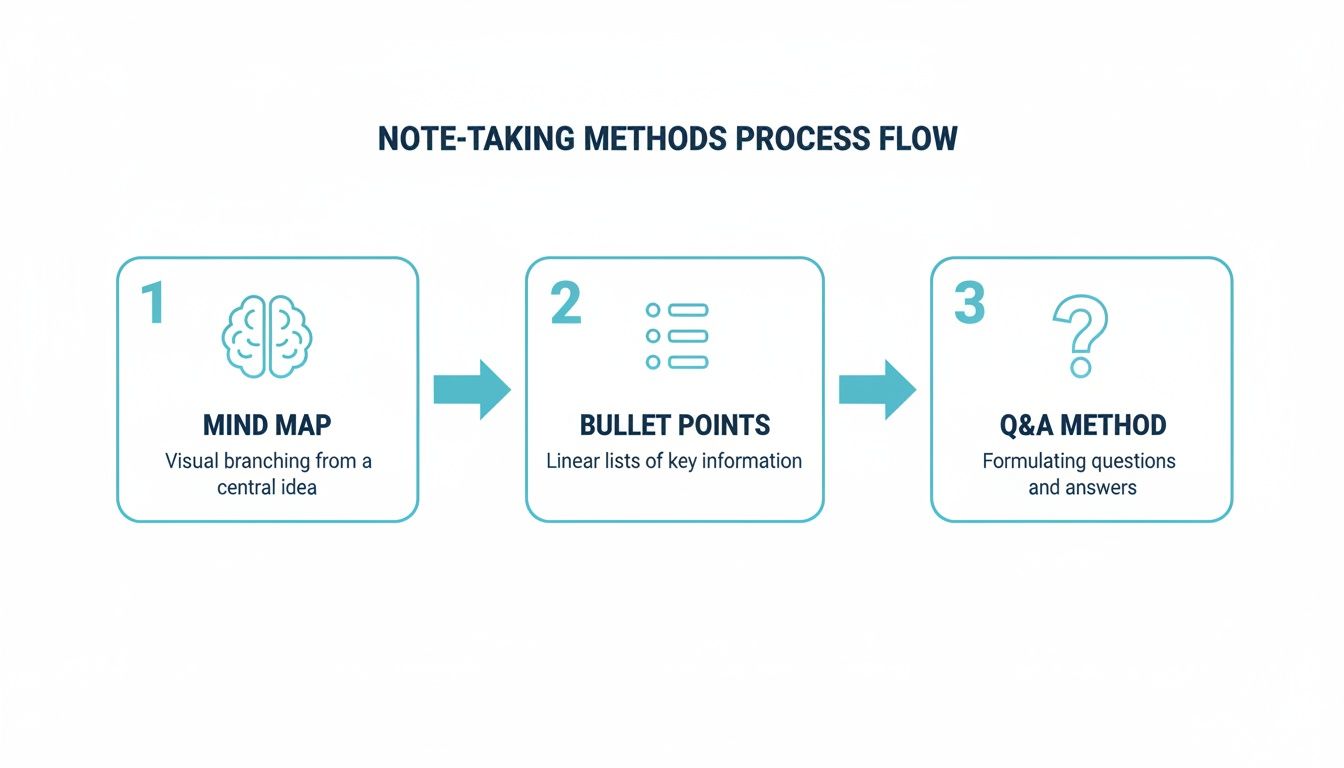
Whether you like to draw maps, make lists, or use questions, each one helps you listen for the choices and jobs that matter. This 15-minute habit is the final step that turns your ideas into real results.
What to Write Down for Your Job
A project leader and a salesperson can be in the same meeting but hear two different things. That's because your job tells you what is important. Taking good notes is not about writing every word. It's about knowing what to listen for—the things that matter for your work.
You don't need a word-for-word copy. Instead, think of yourself as a detective looking for special clues. The clues you look for should help you do your job better.
A Quick Guide: What Different Jobs Should Listen For
Every job looks at things in a different way. A product manager listens for what customers don't like. A boss listens for how much things cost. The goal is not to write everything, but to write the right things. Here is a simple list of what to listen for, based on your job.
| Your Job | What to Listen For | Example Note to Write |
|---|---|---|
| Product Manager | What customers don't like, ideas for new things, tech problems, what users say. | "User Said: 'The new screen is messy, I can't find the export button.'" |
| Boss / Leader | How much things cost, big risks, important choices, if the team is happy. | "Choice: We're stopping Project X to use its $50k for Project Y this summer." |
| Engineer / Coder | What the tech needs, problems that can stop work, talks about tools. | "Problem: Can't work on the payment part until the security team gives us the keys." |
| Marketer / Sales | How customers talk, good things about our product, ideas for ads, start dates. | "Key Words: Customers kept saying it 'saves them an hour a day.'" |
| Designer (Looks/Feel) | What users find hard, words to describe the brand (like 'clean' or 'fun'), ideas to make it easy. | "Feedback: Users think the 'buy' button is 'confusing.' Idea: Try a bright color in a new spot." |
When you listen this way, your notes become a special tool. You will have a paper that is ready to use for your next steps.
If You're a Manager, Listen for What's Stuck
When you lead a team, your main job in a meeting is to see the big picture. You are always looking for anything that could stop the project or slow down your team. Your notes are a map for your team and a to-do list for you.
You should listen for:
- Big Choices: What did we decide that changes our plan?
- Team Problems: What is stopping someone from doing their work right now?
- Jobs for You: What do you need to do to help your team get unstuck?
Let's say a team member says, "I'm still waiting for the money numbers from the money team." A normal note might be "waiting for money team." A manager's note is a job to do: "JOB: I will ask the money team for the numbers for Sarah today."
As a leader, your notes are not just about what was said. They are about what must be done. They are your tool to clear the way for your team.
On a Creative Team? Hunt for Feelings and Ideas
If you are a designer, writer, or marketer, your ears should listen for feelings, new ideas, or what customers think. Your job is to turn ideas into real things. So you need to write down the "why" and the "how it should feel," not just the "what."
Your notes should be full of:
- What Customers Say: Write down their exact words. (Example: "Customers think the 'buy' button is 'confusing'.")
- New Ideas: Write down any new ideas, even small ones. (Example: "Idea: Use a short video on the home page, not a photo.")
- Brand Words: Write down words the team uses to talk about the project's feel, like "fun," "strong," or "simple."
This turns your notes into a page of ideas. When you start your work, you have a list of the feelings and goals you need to follow.
Working from Home? Your Notes Must Be Super Clear
When your team works in different places, being clear is the most important thing. You can't just walk to someone's desk to ask a question. Your notes have to do the hard work. They must be very easy to understand, especially about who does what and when it's due.
For teams that work from home, the most important details are:
- Who Does It: Always write the person's full name next to their job. Don't write "Alex" if you have two people named Alex. Use "Alex P."
- When It's Due (with Time Zone!): Write the date and the time zone so no one gets mixed up. (Example: "Maria to send the report by Tuesday at 5 PM EST.")
- Where to Share It: Say where to post updates. (Example: "Post all new pictures in the #project-phoenix Slack channel.")
Paying attention to these small things stops jobs from getting lost and keeps everyone on the same page, no matter where they are.
Simple Fixes for Common Note-Taking Problems
It's very easy to get into bad habits when taking notes. We've all done it. You leave a meeting with a messy page of writing that you can't understand later. The good news is that the biggest mistakes are also the easiest to fix.
One of the biggest traps is trying to write down every single word. You can't win that game. Your brain can't listen and write everything at the same time. You end up missing the big idea.
A better way is to listen for key words and big ideas. Instead of writing, "We need to make sure we finish the marketing report by Friday," just write "Marketing report due Friday." This little change helps you stay in the talk and write down what matters.
Keep Your Notes Clean and Easy to Read
Another common mistake is ending a meeting with a page full of words that are hard to read. When you look at your notes later, it feels like a big job to find the important parts.
The fix is so simple, it's funny: use blank space. A lot of it.
Start a new line for each new idea. This easy trick makes your notes easy to look at quickly. It gives each idea its own space.
A clean page helps you find what you need in seconds. This is very important because we spend so much time in meetings. In fact, 85% of UK and 78% of US workers are in meetings for over three hours every week. Getting good at notes saves you a lot of time. You can see more in these current meeting trends.
Last, a mistake that can cause big problems is forgetting to write down who is doing what. You remember what needs to be done, but not who is doing it.
A simple shape system can fix this right away. Try this:
- Mark any job with a star (☆).
- Right after it, write the person's name in bold.
For example:
- ☆ Alex to send the new pictures.
- ☆ Maria to tell the client.
Using these simple tricks will make your notes cleaner, clearer, and much more helpful. It's all about writing down what's important, not just writing a lot.
Quick Answers to Your Note-Taking Questions
Here are some fast answers to common questions about taking notes in meetings. These are the little things that can be tricky. But once you have a plan, they become easy.
What if I Can't Keep Up with the Talk?
First, stop trying to write down every word. That will only get you lost. Your job is to find the important things, not to be a copy machine. Listen for the main ideas, the final choices, and any jobs with a name next to them.
Making up your own short words can be a huge help. Using shapes and short words can make you much faster. It's better to write down the 3 most important things from a meeting than to have 30 small details that are confusing.
Should I Use a Laptop or a Notebook?
This is about what works for you and what others in the meeting are doing. A laptop is faster for typing and makes it easy to share your notes. The bad part? It's easy to get distracted by messages, email, and other things on the screen.
I've seen studies that show writing things by hand can help you remember them better. When you use a paper notebook, you have to listen more carefully because you can't write as fast as people talk. It makes you think about the ideas as you hear them.
My advice? Try both. Take a notebook to your next meeting for new ideas. Take a laptop to the weekly update meeting. See which one helps you pay better attention and make notes that are helpful later.
What Is the Best Way to Organize Notes After a Meeting?
The most important thing you can do is fix up your notes right away. Plan for 5-10 minutes right after the meeting ends. Don't wait. Do it while the talk is still fresh in your mind. This one small habit makes a huge difference.
Look through what you wrote and make the important jobs and choices bold. Then, write a short list—I mean 3 to 5 bullet points—and post it in your team's chat or send it in an email. This simple step makes sure everyone knows what happened and keeps the work moving forward.
Stop wasting time on manual note-taking and let AI do the heavy lifting. WriteVoice turns your spoken words into perfectly formatted text in any app, letting you focus on the conversation, not the keyboard. Reclaim your productivity and try it free at the WriteVoice website.