How to Understand Things Faster
Do you want to be faster at learning new things? The secret is to stop reading every single word. You have to train your brain to hunt for the important stuff first. Think of it like looking for a red crayon in a big box of crayons. You don't look at every color. Your eyes just look for red.
Teach Your Brain to Find the Good Parts First
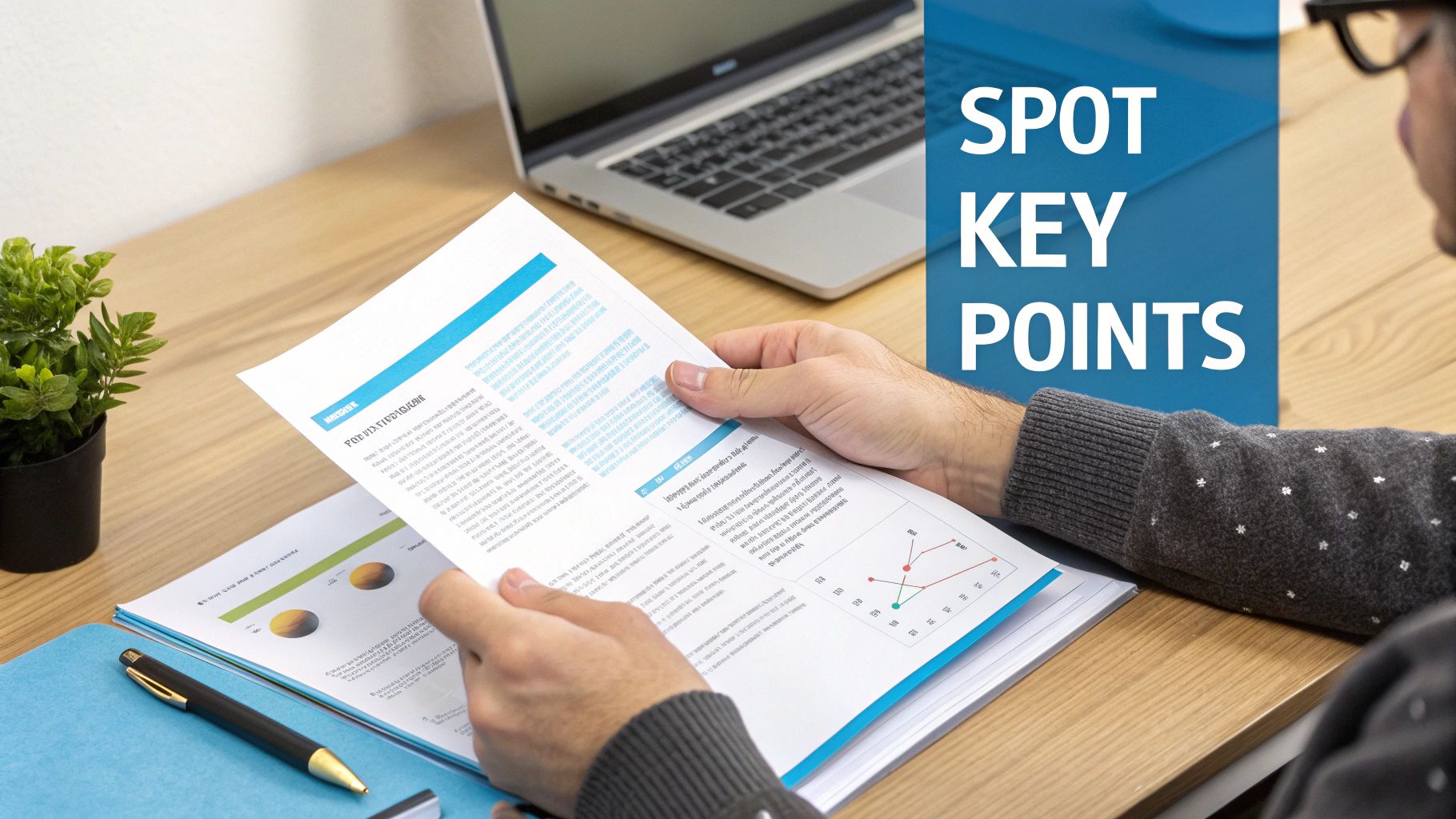
The best way to do this is to teach your brain what to look for in any story, email, or paper.
Most of us were taught to read from left to right, one word at a time. That’s good for storybooks. But it’s very slow for school work or office work. It’s time to teach your brain some new, faster tricks.
Look for Clues Before You Read
First, look over the whole page before you start reading the small words. This is not cheating. It’s just smart. The goal is to get the main idea in about one minute.
This is called skimming. Your eyes move quickly across the page, looking for things that pop out. It’s like looking at a map to find the big cities before you look for the little streets.
Here is what to look for when you skim:
- Big Words at the Top (Headings): These tell you what each part is about.
- Dark or Slanted Words: The writer made these words special for a reason. They are important.
- The First Sentence of a Group of Words: This sentence usually tells you what the whole group of words is about.
- Pictures, Charts, or Graphs: Pictures help you understand the most important ideas very fast.
When you find these parts first, you make a map in your head. Now, if you need to read more, your brain knows where to find the answers.
Finding Answers by Scanning
Another brain trick is scanning. Skimming gives you the big idea. Scanning helps you find one small thing. Think about finding your name on a long list of names. You don't read every name. Your eyes jump around, looking just for your name.
You can do this with your work papers too. If your boss asks, "How much money did we make in the fall?" you don't need to read the whole paper. You can scan for words like "money," "fall," or a money sign ($).
Pro Tip: Before you read anything, ask yourself, "What do I need to learn from this?" This tells your brain what to look for. It makes scanning much easier.
This one question changes reading from just looking at words to a fun hunt. Your brain is now on a mission to find the answer.
Grouping Ideas into Chunks
Your brain can only remember a few new things at once. When you see a big page full of words, your brain can feel tired before you even start. The secret is to break the big page into small, easy pieces.
This is called chunking. We do this with phone numbers. It's easier to remember (555) 867-5309 than 5558675309. You see three small groups of numbers, not ten single numbers.
Use this for your work. Imagine you get a long email about a project. Don't see it as one big block of words. Break it into small chunks with questions:
- What is the main goal?
- Who is on the team?
- When is it due?
- What do I have to do?
When you sort the words using these questions, your brain can understand and remember them better. You are not just reading words. You are building ideas.
Here are some quick ways to use these ideas right now.
Quick Brain Tricks to Start Now
| Brain Trick | How to Do It | Why It Works |
|---|---|---|
| The Quick Look | Before you read, scroll down the page. Only look at big words, dark words, and pictures. | It makes a map in your brain. Your brain knows what is important before you start reading. |
| The Word Hunt | Before you start, pick 1 to 3 words you are looking for. Then, look only for those words. | This turns reading into a game. Your brain learns to ignore the words that don't matter. |
| The 5-Sentence Rule | Try to explain what you read in five sentences or less. | This makes you find the most important parts. It helps you understand and remember better. |
Using even one of these tricks today will help your brain work smarter, not harder. You will be surprised how fast you can find the main idea.
Make Reading Your Superpower

Do you feel like you have too many things to read? You are not alone. We learned how to find the important parts fast. Now, let’s change how you read to make it a skill, not a chore.
Most of us just let the words go into our eyes and hope we remember them. But our brains forget things we don't think about. To really learn, you need to read like a detective looking for clues.
Read Like a Detective
A detective asks questions. You should too! As you read, ask questions in your head. This makes you a part of the story. It helps you understand and remember a lot more.
Before you read the next part of a paper, stop and ask:
- What is the one big idea the writer is trying to say here?
- How does this connect to what I just read?
- Do I agree with this idea?
This little change makes you a thinker, not just a reader. You start to see how all the ideas fit together. That's the real secret to understanding things faster.
Use Your Memory to Test Your Brain
A great way to make sure you remember something is to test yourself. This is called active recall. After you read a page or a part of a paper, just stop.
Look away from the page. Try to say the main points out loud. Or write them down in your own words. The real test is: could you explain it to a friend who has never seen it?
Trying to remember the information makes the memory strong in your brain. It’s like looking at a map once, then trying to find your way from memory. The hard part is what makes you remember.
I once knew a woman who had to give a big talk at work. After reading each part of a long paper, she would close it. Then she would speak a short summary into her phone. This made her understand the ideas, not just read them.
That small change helped her learn what she needed in half the time. She felt sure of herself in the meeting because she really understood the paper.
Remember Things for a Long Time
Once you understand something, you want to remember it. The trick is to look at it again over time. This is called spaced review. Our brains are made to forget things we don't use. Spaced review helps with that.
Instead of studying all at once, you look at the information again and again, with bigger breaks in between. For example, you can look at your notes after one day, then after three days, and then after a week. Each time, you make the memory stronger right when it starts to fade.
This is how you move ideas from your short-term memory to your long-term memory. It's much better than reading the whole thing again every time you need to remember it.
Link Your Brain to Your Hands
Here is a big problem for many people: our brains are faster than our hands. A person can read about 200-250 words in a minute. But most of us only type 40-50 words in a minute. You can learn more from this typing speed research.
This means your ideas are moving much faster than you can write them down.
This is where talking can help. When you say your ideas out loud, you can catch them as fast as you think them. This makes reading and learning much more useful.
A Clean Desk Helps You Think Clearly

A messy computer screen is like a messy desk with papers everywhere. It is hard to think clearly. When your computer is messy, your brain gets tired from just looking for things. It has no energy left for the real work.
Making your computer neat is a big step to understanding things faster. A clean space helps you focus. This is where the real thinking happens.
Make a Simple To-Do List
Most to-do lists make us feel worried. They just get longer and longer. The secret is to stop looking at the whole list at once. You have to choose what is most important right now.
A good trick is to split your list into two parts: "Now" and "Later." The "Now" list should be very short, with only 1 to 3 things on it. These are the most important things for today. Everything else goes on the "Later" list.
This trick helps your brain ignore all the other things. You know you won't forget them, but you can focus on just a few things. To learn more about keeping your files and lists neat, you can look at some document management best practices.
When you focus on only a few things, you feel calm and in control. This calm feeling helps you think hard and understand big ideas without a long list bothering you.
Once you finish your "Now" list, you can move the next important thing over from the "Later" list. It’s a simple way to keep moving forward without feeling stuck.
The Power of Doing One Thing at a Time
People say doing many things at once is good, but it's not true. Our brains can't do it. When we think we are doing many things, we are just switching from one thing to another very fast. Each time you switch, you lose time and make more mistakes.
This is why doing one thing at a time is so powerful. It means you give all of your attention to one job until it is done.
Think about it. You are trying to read a hard paper, but new email messages keep popping up. Your brain has to stop reading, look at the email, decide if it's important, and then try to find your spot in the paper again. This wastes a lot of brain power.
Here’s how to do one thing at a time:
- One tab only: Close all the pages on your computer that you don't need for your one job.
- Be quiet: Turn off the sounds on your phone and close your email and chat for a short time. Even 30 minutes helps.
- Use a timer: Set a timer and promise to work on only one thing until it rings. Knowing there's an end makes it easier not to get distracted.
This helps you think deeply. It lets you connect ideas and understand things much better.
Make Meetings Easier
Meetings can be like trying to drink from a fire hose. There are so many ideas and so much talking. At the end, it's hard to remember who said what and what you decided to do. The trick is to stop trying to remember everything. Only listen for two things: decisions and actions.
Don't try to write down every word. Instead, listen for key sentences like, "So, we decided to…" or "Okay, Sarah, you will do…" Those are the important parts.
During a meeting, keep a simple list with two parts:
- Decisions Made: What did everyone agree on?
- Things to Do: Who is doing what, and by when?
This simple way cuts through all the talk. When the meeting is over, you have a short, clear list you can use right away. This frees up your brain for the work you need to do next.
Use Smart Tools to Help Your Brain
Your brain has a limited amount of energy for hard work. Think of it like a phone battery. If you use all its power on easy things like typing, you won't have any left for the hard things like solving problems.
This is where smart tools can help. They are like a power pack for your brain. They do the easy, boring work so you can save your brain energy. This is a big part of learning how to process information faster. You don't work harder. You just let tools do the busywork.
Talk, Don't Type
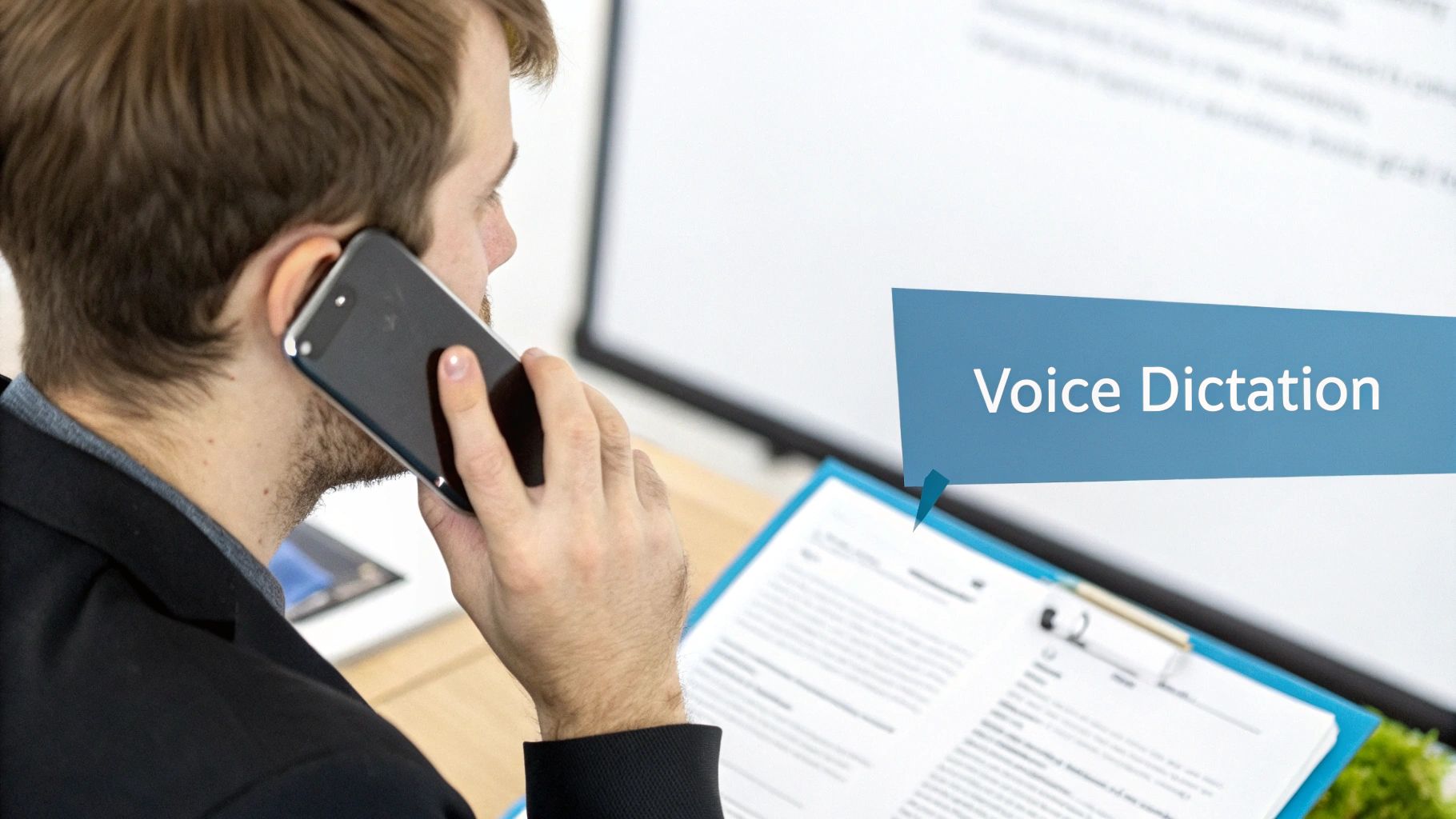
One of the biggest things that uses up your brain's battery is typing. You have a great idea, but you have to stop, open a new page, and hope your fingers can type as fast as you think. By the time you type it all, your idea might not feel as good.
Talking your ideas changes everything. Instead of stopping to type, you just speak. It is a much faster way to get your thoughts into words.
Imagine you are a computer coder and you find a mistake in the code. The old way is to click to another window and type a long note about it. The new way? You just talk. With a tool like WriteVoice, you can speak your note right into your work tool while the code is still fresh in your mind.
This keeps you focused on your work. You don't have to switch from "thinking" to "typing." You just think out loud, and the tool writes it down for you.
Easy Ways to Use Your Voice
This "talk, don't type" idea is not just for special jobs. You can use it for many parts of your day.
Here are some real examples where it helps a lot:
- Writing Emails While You Walk: You are walking back from a meeting and think of the perfect thing to say in an email. Instead of trying to remember it, just speak the email into your phone. It is saved right away.
- Making a To-Do List While You Work: You are busy with a project and remember you need to ask a friend for help. Don't stop what you are doing. Just say, "Make a note to email Sarah about the money," and it's added to your list.
- Taking Notes in a Meeting: It is hard to type fast enough to get everything that is said in a meeting. If you record the meeting, you can just listen and be a part of the talk. You will have a perfect copy of the words later.
Using your voice to save your ideas is like having a helper who works as fast as you can think. It makes it easier to turn an idea into an action. This helps you get more done.
We use our phones a lot, but this has made us slow typists. Most people type on a phone at only 36 words per minute. It is also true that not many high school students learn how to type on a keyboard anymore. This means new workers don't have the typing skills to be fast on a computer.
Choosing the Right Voice Tool
Not all voice tools are the same. A tool should be fast, correct, and very easy to use. A tool that is slow or makes a lot of mistakes just makes you more upset.
When you look for a tool that turns your voice into words, find one that works with the other tools you use every day. It should work with your email, your chat, and your project planner. You can find a good list of what to look for in this guide to the best speech-to-text software.
A great tool should be so easy you forget it's there. It works in the background and is ready when you need it.
The goal is to make things easier. When you don't have to work hard to save your ideas, your brain has more power. You can use that power for the important work that really matters.
Simple Daily Games to Make Your Brain Stronger
You don't get faster at understanding things just by wanting to. You have to train your brain, just like a muscle. The good news is this doesn't take a lot of time. Think of these as quick, daily brain games to make you sharper.
One of the best games is the One-Sentence Summary. It sounds easy, but it works very well. Pick a story or an email. Read it one time. Then, make yourself explain the whole thing in just one sentence.
The one-sentence limit is the important part. It teaches you to find the main idea and forget the extra words. If you do this for just a week, you will be very good at finding the most important part of anything you read.
Another good game is the Quiet Time. This is not about getting rid of news forever, just for a short time. For 15 minutes, turn off all the noise. Close the fun websites, turn off the news, and be quiet. This short quiet time helps your brain get ready to focus on what is really important when you turn things back on.
How to Do the One-Sentence Summary
Ready to try? Here is how to start.
Find a news story that is short. Read it one time, then close it. No peeking! Now, write down the main idea in one sentence. Do this every day for a week. See how long it takes you.
- Pick a story you like. It makes it feel less like work.
- Keep your sentence short. Under 20 words is best.
- Try to do it in less than two minutes.
This game teaches your brain to find the important signal and ignore all the noise, and to do it fast.
From Words to Speaking: Catch Your Thoughts Fast
Now, let's use a different part of your brain. The Voice Game uses a tool like WriteVoice to catch your thoughts as you say them.
Just set a timer for five minutes. Start talking about a problem you have or a project you are planning. Don't worry about saying the right thing. Just let your ideas come out. When you are done, read what the tool wrote down. You will often find great ideas that you might have lost if you tried to type them.
| Game | How Long | What It Helps |
|---|---|---|
| One-Sentence Summary | 2 minutes | Helps you focus on main ideas |
| Quiet Time | 15 minutes | Helps calm your brain and stop distractions |
| Voice Game | 5 minutes | Helps you catch your ideas faster |
See How Much Better You Get
You can't get better if you don't know where you started. Keep a list of your daily brain games in a notebook.
For each day, write down the date, the game you played, and how it went.
- How long did it take to write your one sentence? Was it a good sentence?
- How many times did you want to look at something else during Quiet Time?
- Are you getting faster at talking your ideas?
Seeing your list will make you feel good. It is proof that you are getting better.
A Few Tips to Keep Going
Doing a little bit every day is better than doing a lot one day.
- Add it to a Habit: Do a brain game right after something you already do, like drinking your morning coffee. This helps you remember.
- Use it for Real: Use the Voice Game during a real meeting to take your notes. It's good practice.
- Think About Your Week: At the end of the week, think about how you did. What was easy? What was hard?
Don't forget to be happy about small wins. Getting faster with your brain is a long journey, not a short race. To help plan your new games, look at our guide on best practices for time management.
Keep doing these simple games, and you will see your brain get stronger and faster over time.
Got Questions? Let's Answer Them
When I talk about understanding things faster, people always ask the same questions. It is normal to have questions when you start new habits. You have the tricks, so let's answer any questions you still have.
Remember, being faster is not about being a robot. It’s about working with your brain, not against it.
How Fast Will I See a Change?
You can feel a change in just a few days. You don't have to wait months to see that these tricks work. Small changes make a big difference right away.
For example, if you just try skimming your emails for one week, you will probably clean out your email box 20-30% faster. The trick is not to change everything at once. Just pick one thing.
- Start by skimming your morning emails.
- Next week, try the One-Sentence Summary with a news story.
- The week after, use chunking for one long paper for a project.
It will take a few weeks for these skills to feel easy and natural. The secret is to start small and build up. This is how you make new habits that stick.
I think of it like learning to ride a bike. At first, you are wobbly and you have to think about everything. Soon, you are riding without even thinking about it. These brain skills work the same way.
Will These Tricks Work if I Am Bothered a Lot?
Yes, for sure. In fact, they are made for people who work in busy, noisy places. A busy office is where these skills really help.
Tricks like doing one thing at a time teach you to work in short, focused bits. When you only have one small job open on your computer, it is very easy to get back to work after someone stops to talk to you. You don't lose your spot.
This is also where a good voice tool can save the day. Saying a quick thought out loud takes only a few seconds. That means a phone call won't make you forget the great idea you just had.
These tricks help you work in small, strong bursts. This is the perfect way to handle a day where you are always being interrupted.
Is It Better to Read on a Screen or on Paper?
That's a great question. The answer depends on what you are trying to do. One is not better than the other. They are just different tools for different jobs.
For finding one small fact, computer screens are the best. You can use the search tool (Ctrl+F or Cmd+F) to jump right to the word or number you need. It’s like having a superpower to find a needle in a haystack.
But, when you need to understand and remember big ideas, many people find that paper is better. A real page has no pop-ups or other fun websites trying to get your attention. It sends a message to your brain: "This is important. Focus."
A good idea is to use both.
- Screen for a Quick Look: Use your computer to quickly skim and scan many papers. This helps you find what is really important.
- Paper for Deep Work: Once you find a paper that you need to really focus on, print it out.
This two-step plan gives you the best of both worlds: the speed of the computer and the focus of paper.
Ready to stop letting typing slow you down? WriteVoice turns your spoken words into clean text in any app you use, letting you capture ideas at the speed of thought. See how much faster you can work by trying it today at https://www.writevoice.io.