
How to Stay Organized at Work and Feel Good
Does your to-do list feel like a big, scary monster? You are not the only one. The secret to being neat at work is not a hard plan with many colors. It is much easier.
Try this: pick one big thing to do tomorrow before you go home today. This small habit gives you a clear start for the next morning. It helps you feel less mixed up and ready to do good work all day.
A Simple Start to a Good Workday
Feeling like you have too much to do and a messy desk is normal. The good news? You do not need fancy apps or to change your whole life to feel calm. Being organized is about making small, easy habits that make a big change over time.
Do not try to do everything at once. That will make you very tired. Instead, build a simple, strong base. We will show you some easy tricks that will help you feel less stressed and more proud of your work every day.
Why Small Habits Are a Big Deal
Think of small, smart actions as the building blocks for a neat work life. When you make a clear plan for your time and your space, you clear out the mess in your head. This lets your brain think about the important things.
Starting your day with a clear plan is not just for you. It helps everyone. This focus is a key part of how to improve employee productivity and boost your business.
A plan does not just feel better—it works. It’s about making a system that is good for you. It gives you control over your day instead of letting your day control you.
And we can prove it. People who plan their work in blocks of time get more done. Studies show they finish 23% to 29% more big tasks each week than people who just do tasks as they show up.
Your Quick Start Guide for a Tidy Day
Feel ready but not sure where to start? Do not worry. Just pick one or two things from the list below and try them tomorrow. See how you feel.
| Morning Action (5 Minutes) | Why It Helps You | Afternoon Check-In (2 Minutes) |
|---|---|---|
| Look at your top 3 tasks | Gives you a clear goal so you don’t get lost in small stuff. | Look at your calendar for tomorrow |
| Clean off your desk | A clean desk helps you think clearly with less to look at. | Delete or file 5 emails |
| Check your meetings | Helps you get your mind ready for the day’s talks and teamwork. | Pick your #1 task for tomorrow |
The goal is not to be perfect. The goal is to get better. A few minutes of planning can change your whole day. It helps you feel in charge from the moment you start.
Sorting Your Tasks with Now, Next, Later
When your to-do list is a big mess, it is easy to feel scared. But you do not have to do it all at once. One of the best ways to make things neat is the Now, Next, Later method. It is a simple way that shows your brain what to do next.
Think of it like putting away food from the store. You would not leave it all on the counter. The ice cream goes in the freezer first, right? That is your “Now” task—the most important thing for today.
This easy sorting trick helps you feel calm right away. It gives you a real plan, so you know where to put your energy. You can start right now with a notebook or a simple notes app.
How to Make Your Lists
Making the lists is easy. Just make three columns or lists. You don't have to be perfect. The goal is just to get all the tasks out of your head and onto paper where you can see them.
- Now: These are your "ice cream" tasks. They are very important and must be done today. Keep this list small—no more than three to five things—so you can focus.
- Next: This is your "waiting" list. These are tasks for tomorrow or the next day. They are important, but they can wait a little bit.
- Later: Think of this as a parking lot for everything else. It is a home for good ideas, big projects, and any task that can wait until you have more time.
This method is not about doing more work. It is about doing the right work at the right time. When you sort your tasks, you make space in your mind and feel less stress.
This system works best if you look at it every day. At the end of the day, take five minutes to look at your lists. Move things around. A "Next" task might become a "Now" task for tomorrow. This quick check is one of the best practices for time management.
Making a Workspace That Helps You Think
Your desk can be your helper or your biggest problem. I have seen it many times: a messy space can make your mind feel messy. But you do not need to do a big clean-up. A few simple habits can turn your desk into a calm, helpful place.
Let’s start with your real desk. The main rule is simple: everything needs a home. Your stapler, your pens, your notepads—they all need their own spot. When you are done with something, put it back in its home. This sounds very simple, but it stops messes from ever starting.
A quick, five-minute clean-up at the end of each day helps a lot. You will come in the next morning feeling fresh and ready, not stressed by yesterday's mess.
Cleaning Your Computer Desk
The same idea works for your computer screen. A desktop full of files is like a messy desk. Looking for one file is like a treasure hunt with no map. It is a common problem, but the fix is easy.
Start by making a few main folders. You do not need a hard system. Just use clear names that make sense to you.
- Working On: For anything you are doing right now.
- Finished Work: A place to put work that is done. It's out of your way but you can find it later if you need to.
- Important Info: For things like company rules or information you use a lot.
A clean computer is just as important as a clean desk. When you know where to find your files, you stop wasting brain power on searching. You can focus on the real work.
Just like with your real desk, take two minutes before you log off to put new files in their folders. It is a small bit of time that helps keep your computer from getting messy. There are great tools that can help, and you can look at the best tools for remote workers to find one you like.
Catching Ideas Before They Fly Away
We have all had it happen. A great idea pops into your head, but by the time you get to your desk, it is gone. Ideas can be quick to leave. If you do not catch them right away, they can disappear.
The easiest tool is already in your pocket: your phone. Instead of looking for a notebook, just use your phone. Open the voice memo app and say your idea out loud. It is faster than writing on a napkin and you won't lose it. It is like leaving a quick message for yourself.
Turning Your Voice into Words
Recording the idea is the first step. The real magic happens when you turn that recording into something you can use, like text. This is not hard to do anymore. New tools can listen to your words and write them down for you. It is like having a helper who catches every word.
For example, after a call, you could record a 60-second voice note about what you talked about. A tool then turns it into text. You can put it right into an email, a Slack message, or a new task in Jira. This is a great way to keep moving forward. You can learn more about using speech-to-text for note-taking.
The goal is to make it super easy to save an idea. The easier it is, the more you will do it. And you will lose fewer great ideas.
This is about more than just ideas. It is about making your whole world ready for you to focus. That means getting your real space and your computer space organized.
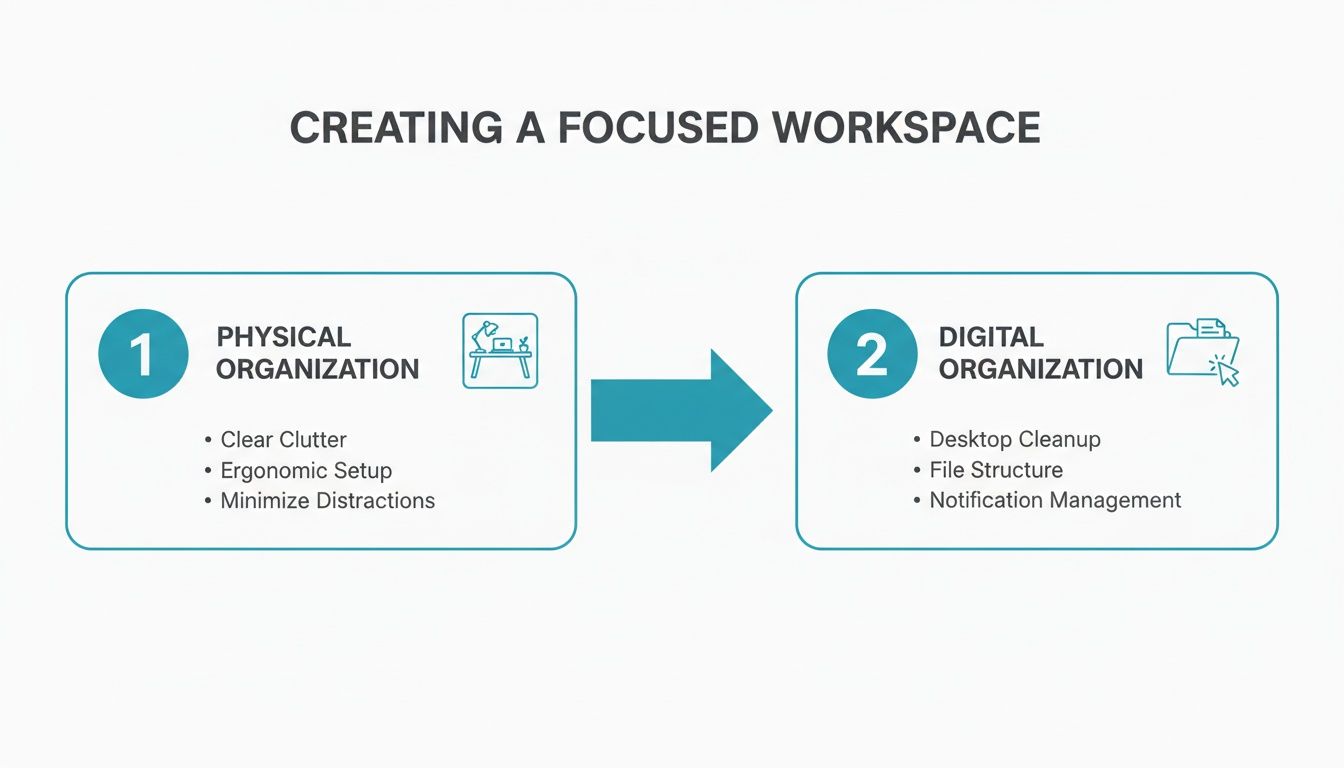
Being truly organized is not just about a clean desk or email. It is about both. When you have simple, clear systems for your desk and your computer files, you stop wasting brain power looking for things. Then you can finally focus on the work that really matters.
Your 10-Minute End-of-Day Plan
How you finish your day is as important as how you start it. The last ten minutes are not for one more email. They are your secret for a great tomorrow. A simple end-of-day plan tells your brain that work is done. This helps you rest and start the next day fresh, not messy.
This is not about working more. It is about making a calm and clean break from work. Think of it as a small habit that gives you a big reward: a clear mind.
Your Simple End-of-Day List
First, look back at your "Now, Next, Later" list. Take a moment to see what you finished. Feeling proud of what you did is a great way to stay motivated.
Next, pick one important task for tomorrow's "Now" list. This is the best thing you can do to have a good morning. You will walk in knowing what to do first. This stops that morning rush and feeling of having too much to do.
Last, take two minutes to clean your desk using the "Everything Has a Home" rule. Put pens away, stack papers, and wipe the desk.
This short plan does more than just clean up. It makes a wall between your work life and your home life. It is a clear sign that the day is done. This lets you turn off your work brain and rest.
Planning your day's end is a smart way to use your time. Companies that make rules to stop wasting time—like having clear plans for meetings—gave workers back 30 to 60 minutes each day. Your 10-minute plan does the same thing for you. It makes sure your time is spent on what matters most. You can find more facts like this in this workplace statistics report.
How to Get Clear Help from Your Manager
Feeling lost at work often starts with one problem: you are not sure what is most important. When your boss gives you five "top priority" tasks, it is normal to feel worried. Where do you start?
Asking for help is not weak—it is one of the smartest things you can do.
Try starting with a simple question like, "I want to do the most important work first. Can you help me put these tasks in order for the week?" This shows you are thinking ahead and want to do a great job.
Why Asking for Help Is a Good Thing
Good bosses want their team to do well. Part of their job is to clear the way for you. When you ask for clear goals, you are not just helping yourself. You are helping them lead the whole team in the right direction.
Being clear helps a lot. Studies show that when bosses give good help and explain jobs clearly, companies have to fix 18% to 35% fewer mistakes. You can read more about how manager engagement affects productivity to see for yourself.
Getting clear instructions is not about being told what to do. It is about making sure your hard work is pointed at the right goal. This is how a team stays organized and does great work.
A big part of this is also learning what work to keep and what to give to others. Learning to share work is very important. You can find great tips on how to delegate like a founder to get started.
Common Questions About Staying Organized
When you start to build new habits, some questions always come up. Let's answer them.
What If My Desk Gets Messy Again?
It will. Let's be real—a perfectly clean desk is not the goal. The real secret is having a plan for when it gets messy.
Your best plan is a simple 10-minute clean-up at the end of each day. A quick reset every afternoon is much easier than cleaning a huge mess on a Friday. It stops the mess from getting too big.
How Do I Handle Too Many Emails?
Stop trying to put every email in a folder. Email programs today have very good search tools. It is time to trust them.
Here is an easy idea that works very well:
- Flag it: If an email needs an answer, flag it. This makes it stand out so it is easy to see.
- Archive it: When you are done with an email, archive it. It goes away from your main inbox but you can still search for it later.
This simple "flag and archive" trick changes your inbox from a messy to-do list to a clean space. You only see what you need to do right now. It feels so much better.
What Is the Most Important First Step?
The best habit you can build is to pick your #1 task for tomorrow before you leave today.
Knowing exactly what to do when you sit down at your desk gets rid of that morning confusion. It sets a good, busy mood for the rest of your day. It is the key to how to stay organized at work.